Reserves
Rolling reserves at Shopify, Stripe and PayPal explained
November 16, 20266 min readLaminar Checkout Team
Part of our guide: Shopify Payments reserve: causes, terms and what you can do
A reserve notice is stressful. Part of every sale is suddenly held back, and your payouts shrink. The good news is that a reserve is not a fine. The money is still yours. It is held for a set period to cover refunds and chargebacks that may arrive later.
This post explains how reserves work at Shopify Payments, Stripe and PayPal, using each provider's own help pages. Then it covers what you can control, and what you cannot.
This is general information, not legal advice. Laminar Checkout is independent and not affiliated with Shopify, Stripe or PayPal. Your reserve terms come from your provider, and they override anything general.
What a reserve is for
When a customer disputes a charge, the provider pulls the money back from you. If your balance cannot cover it, the provider may be left with the loss. A reserve is a cushion against that risk.
Stripe says this plainly in its reserves support topic: refunds and chargebacks are pulled from the reserved balance, and reserves do not stop you from accepting payments. Shopify says the same in its overview of reserves in Shopify Payments. PayPal's What are reserves? page describes it as money that is still yours but that you cannot use or withdraw for now.
Rolling reserves and fixed reserves
Providers use different names, but most reserves fall into two shapes.
Rolling (percentage) reserves
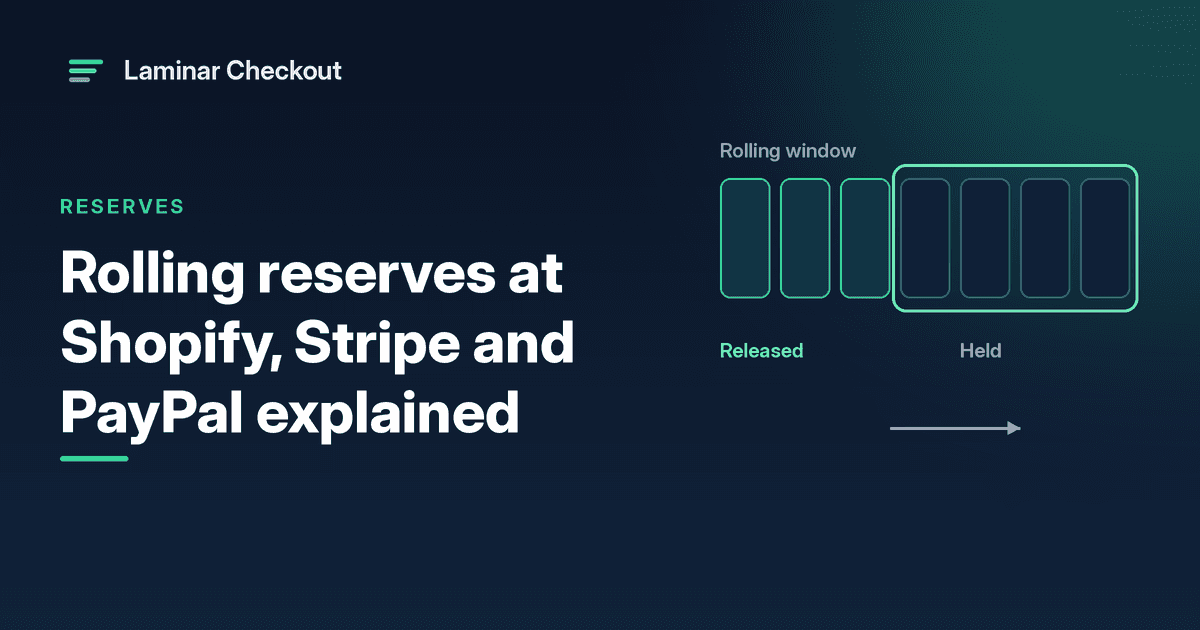
A set percentage of each sale is held for a set number of days. Each slice is released when its own window ends. After the first window passes, money flows in and out of the reserve every day.
- PayPal calls rolling reserves its most common type. Its example is 10% held for a 90-day rolling period: money held on day 1 is released on day 91.
- Stripe describes a rolling reserve as a percentage of each new transaction held on a rolling basis. Its worked example uses a 25% reserve with a 30-day window. Stripe says reserve periods are normally 30 to 90 days.
- Shopify Payments calls it a percentage-based reserve. Its example holds 10% of each transaction for 120 days and pays out the other 90% as normal.
Fixed and minimum reserves
A fixed reserve sets aside a specific amount or holds funds until a set release date.
- Shopify gives the example of $1,000 held for 120 days after a period of increased sales.
- Stripe describes fixed reserves as a percentage of each new transaction held until a specified release date.
- PayPal uses a minimum reserve: an amount you must keep in your balance. It may be built up over time or held all at once, which PayPal calls an upfront reserve.
The examples above are illustrations from each provider. Your actual percentage and period are in your notice.
Why a provider sets a reserve
Each provider publishes the kinds of signals it weighs.
Shopify's reserves page lists extended billing cycles such as annual plans, elevated chargebacks, an increased refund rate, extended delivery timelines such as preorders and custom orders, and significant volume surges.
PayPal's page on why money is held in reserve lists account age, time in business, processing history, industry, claims and disputes, credit history, preselling, and delivery time frames.
Some of these you cannot change quickly, such as account age or industry. Others are about how you sell and how clearly you explain it.
What you can control
Delivery promises
Delivery time shows up on both lists. Publish processing and transit times separately, with ranges you can meet. Label preorders with an expected ship date on the product page. Update the page when timelines change, and tell affected customers.
Refund clarity and speed
PayPal suggests avoiding long refund times, which lead to complaints. Publish a clear return window and process, state how fast refunds are issued, and then meet that timeline. Our post on how clear checkout policies reduce chargebacks goes deeper on this.
Billing terms
If you sell subscriptions or annual plans, show the price, billing frequency, renewal and cancellation steps before the first charge. Make cancelling easy to find.
Communication
PayPal recommends communicating early and often with buyers and giving valid tracking information. A visible support email and phone number, answered promptly, gives customers a path that is easier than calling their bank.
Consistency across pages
Your contact details, policies and checkout should tell the same story. A reviewer who finds a 14-day return window in one place and 30 days in another has a reason to dig further.
What you cannot control
Be realistic about the limits.
- The provider decides. Shopify says each reserve has an expiry date and a risk assessment decides whether to lift, keep, reduce or increase it. PayPal says reserves are reviewed within 180 days of placement.
- Some reserves never fully go away. PayPal says that depending on your industry and credit history, you might never be able to fully remove a reserve.
- Some reserves cannot be appealed. Shopify says that when a reserve email lists specific requirements, you meet those instead of appealing. The reserve is then removed automatically.
- Released amounts can shrink. Stripe's reserve releases report notes that reserved funds can be used for refunds, disputes or a negative balance before their release date.
What to do when a reserve is placed
- Read the notice closely. Note the percentage or amount, the period, and any listed requirements.
- If the notice invites an appeal, reply within the stated timeframe. Explain what changed and attach evidence.
- Track the reserve. In Shopify, go to Finance > Payouts and open Reserve. Stripe shows scheduled releases in its reserve releases report.
- Plan cash flow around the held portion. Do not count on an early release.
- Fix the visible gaps on your store so the next review sees a clearer picture.
If you would like help working the case, our reserve release service prepares and manages the release request with your provider. The fee is 3% of funds actually released, and nothing if they are not. We cannot promise a release.
FAQ
Is a rolling reserve the same as a frozen account?
No. A reserve holds part of your funds while you keep selling. An account hold or closure can pause payouts entirely. Our Q4 payout hold checklist covers holds.
How long do reserves last?
It depends on your notice. Stripe says reserve periods are normally 30 to 90 days. Shopify's example uses 120 days. PayPal reviews reserves within 180 days.
Will better policies get my reserve lowered?
They can help a review, but they do not decide it. Refund and dispute history, delivery performance and other factors also count.
Start with what a reviewer can see
Run a free scan of your public pages. Laminar checks contact, refund and return, shipping timelines, pricing and fees, privacy and consent, and legitimacy. You get a 0–100 compliance score with pass, warning and fail counts in under a minute, with no app install or login. It is informational. A good score does not prevent a reserve.