Compliance
FTC SHEIN settlement: what your store should check
November 25, 20267 min readLaminar Checkout Team
Part of our guides: Guides for Shopify merchants · Start with the pillar: A Shopify checkout compliance checklist
On November 24, 2026, the Federal Trade Commission filed a complaint and a proposed stipulated order against three SHEIN entities in the U.S. District Court for the Central District of California. The proposed order would enter a $100 million judgment as monetary relief.
This is not a checkout billing case or a subscription case. The charges are about shipping-delay notices and refunds under the Mail, Internet, or Telephone Order Merchandise Rule (MITOR), customer service, consumer reviews, and unsubstantiated product-sourcing claims.
The proposed order states that the defendants "neither admit nor deny any of the allegations in the Complaint, except as specifically stated in this Order." The FTC's press release says the Commission vote authorizing staff to file the complaint and stipulated final order was 2-0, and that stipulated final orders have the force of law when approved and signed by the District Court judge.
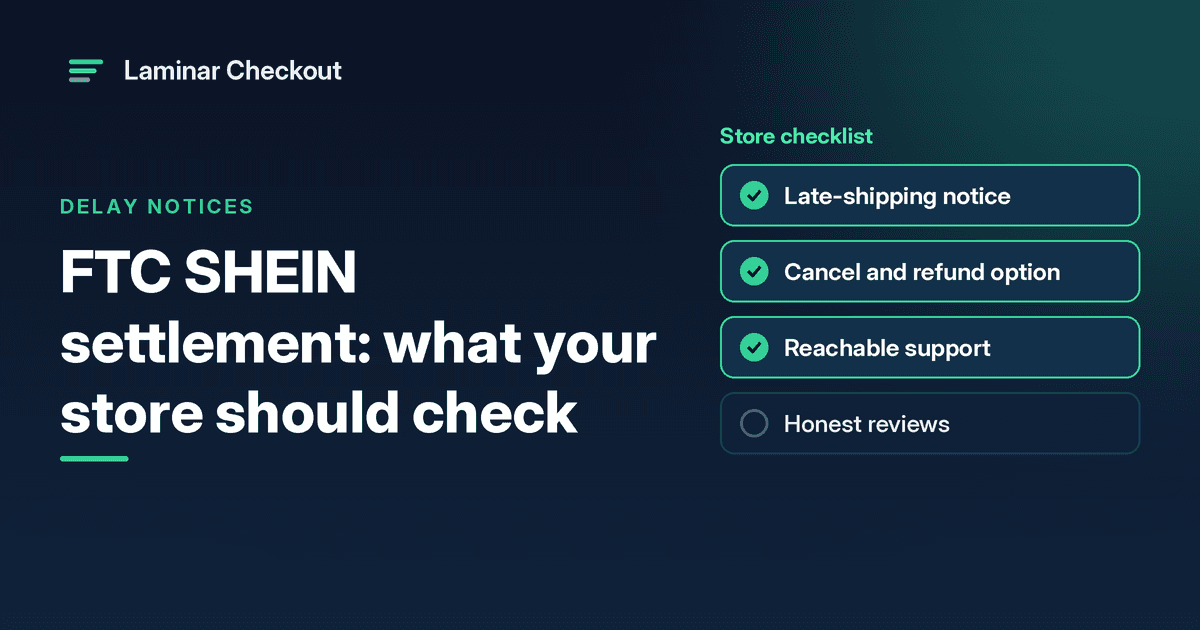
In our view, FTC risk does not end at the pay button. Shipping-delay notices, a cancel-and-refund option, reachable support, and honest reviews after the purchase all count. This post turns the FTC's documents into a checklist for your store. Laminar Checkout is independent of Shopify. This is general information, not legal advice.
What did the FTC allege?
The proposed order's findings describe the charges as failing to offer consumers, "clearly and conspicuously and without prior demand," a choice to consent to a shipping delay or to cancel and receive a prompt refund when merchandise was not shipped in the time MITOR requires, and failing to treat an order as cancelled and make a prompt refund; providing unfair customer service; making unsubstantiated statements about evoluSHEIN products and cotton traceability; and using deceptive consumer review practices.
The complaint says that "even though SHEIN ships nearly one million packages into the U.S. every day, for years SHEIN had no customer service via phone, and as of September 2025 had only five agents." It also alleges that SHEIN did not list a phone number on its website. These are allegations in a proposed settlement, not findings a court has already made. SHEIN has not admitted them.
What do I owe customers when an order ships late?
The complaint describes MITOR (16 C.F.R. Part 435) as requiring sellers, when they learn they cannot ship within the time they stated or within 30 days, to notify the customer and to get the customer's consent to the delay.
Check what your product pages, shipping policy and order emails actually promise. If a date or a window is on the page, that is the time you need to watch. If a shipment will miss it, tell the customer without waiting for them to chase you.
Do I have to offer a refund?
According to the complaint's description of MITOR, yes, in the cases the rule covers. If you cannot get consent to the delay — because the customer does not agree, or because their silence cannot be treated as consent — you must promptly refund the money paid for the unshipped merchandise, without waiting for the customer to ask. The proposed order also charges a failure to offer that cancel-and-refund choice clearly, and without the customer having to demand it.
On your store:
- State shipping times you can actually meet.
- Send a delay notice when you will miss them.
- Offer the cancel-and-refund option in that notice, not only after a complaint.
- Process the refund promptly when the customer declines the delay, or when you cannot get consent.
A clear shipping policy helps customers know what to expect. It does not replace the notice and refund steps the FTC describes.
How reachable does my support need to be?
The complaint does not set a staff count every store must copy. What it alleged is that buyers could not reach anyone who could resolve shipping, delivery and other problems.
Publish contact methods you monitor, and make sure those channels can handle late shipments and refunds. Put an email and, if you have one, a phone number or address in the footer and on the contact page. If you list a phone number, someone should answer it. If you only offer email or chat, reply in a time a customer can use, and let that person issue a refund or confirm a new ship date.
What review practices get flagged?
The complaint alleges that SHEIN approved higher-star reviews containing "helpful" terms for publishing, held back lower-star reviews with the same content, and suppressed reviews related to returned products. The FTC brought those charges under the Rule on the Use of Consumer Reviews and Testimonials (16 C.F.R. Part 465), which the complaint says prohibits certain review suppression practices.
Do not hide, delay or delete reviews because they are negative, because a product was returned, or because they use words you would rather not show. If you moderate reviews, use the same process for low-star and high-star feedback. If a review is removed for a lawful reason, keep a record of why. In our view, the ratings on a product page should reflect what buyers actually said.
Can I make sustainability claims?
Only if you can back them up. The proposed order charges unsubstantiated statements about evoluSHEIN products and the traceability of the cotton in those products. The complaint alleges that SHEIN represented evoluSHEIN suppliers as earning "above average" ratings in social compliance audits, and that it did not provide the FTC even one such audit. It also alleges that, in numerous instances, third-party testers found that cotton claimed to be grown in the United States was actually from China.
If your pages talk about organic materials, country of origin, factory audits, or a "responsible" line, keep the records that support each claim. Our post on product claims that put payment accounts at risk covers how product-page wording can also draw a payment review.
What should I check on my store?
- Shipping times on product pages, at checkout and in the shipping policy match, and you can meet them.
- You can send a delay notice when you will miss a stated time or, if you stated no time, the 30-day window the complaint describes.
- That notice offers a clear choice: consent to the new date, or cancel and get a prompt refund, without the customer having to demand it.
- Refunds for unshipped orders go out promptly when the customer declines a delay or you cannot get consent.
- Contact details on the site work, and the people behind them can resolve shipping and refund issues.
- Reviews are not filtered to favor high-star or pre-return feedback.
- Sustainability, origin and audit claims have records behind them.
For a wider pass, start with our Shopify checkout compliance checklist and the other guides. Our earlier post on FTC billing cases covers a different set of actions, about fees, cancellation and prices at checkout. If you want a structured review of your public pages, see compliance review.
FAQ
Does this settlement apply to my Shopify store?
No. The complaint and proposed order name SHEIN entities. The rules the FTC cited, including MITOR and the Reviews and Testimonials Rule, are not limited to one retailer. Check your own shipping notices, refund path, support and reviews, and ask a lawyer about your obligations.
Has the $100 million order taken effect?
Not yet. It is a proposed stipulated order. The FTC's press release says stipulated final orders have the force of law when approved and signed by the District Court judge. The proposed order would enter a $100 million judgment as monetary relief and require payment within 30 days of entry.
Did SHEIN admit the allegations?
No. The proposed order says the defendants neither admit nor deny the allegations in the complaint, except as specifically stated in the order.
Do I have to offer phone support?
The complaint does not state a phone-support rule for every merchant. What it alleged is that customers could not reach anyone who could solve shipping and delivery problems. Publish contact methods you actually monitor, and make sure they can resolve late shipments and refunds.
Will cleaner policies prevent an FTC action?
No. Clear notices, a working refund path, reachable support and honest reviews reduce confusion and give you a better record. They do not prevent a complaint or an investigation.
Check the pages customers use after they pay
Delay notices, refunds, support and reviews sit after the pay button, but they still matter to regulators, payment reviewers and customers. Run a free scan to see how your public pages treat contact details, refund and return terms, shipping timelines, pricing and fees, privacy and consent, and legitimacy. You get a 0–100 compliance score (Low risk 86–100, Medium 61–85, High 0–60) with pass, warning and fail counts, usually in under a minute, with no app install. Results are informational, not legal advice. A public-page scan cannot confirm that your delay notices or review filters work as they should.