Agentic commerce
PayPal agentic virtual card terms: what to check
November 24, 20266 min readLaminar Checkout Team
Part of our guide: Shopify Payments alternatives: what to check before you switch or add a provider · Start with the pillar: AI shopping agents read your store policies too
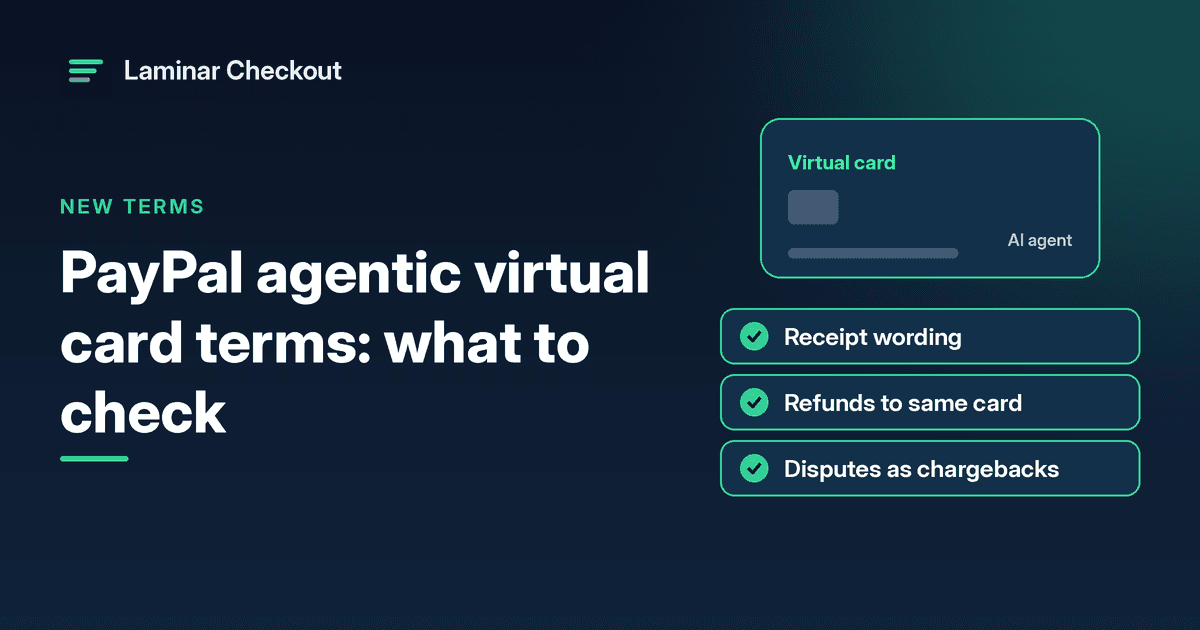
PayPal's Agentic Commerce Merchant Virtual Card Terms are last updated on November 23, 2026. If you accept PayPal, an order that looks like a PayPal payment to the shopper can now be settled to you on a virtual card. That means card processing costs, card-network chargebacks, and no Seller Protection.
PYMNTS reported on November 23, 2026 that PayPal announced the terms on November 10, and that the new payment type applies to "eligible U.S. business accounts." Check your PayPal account and processor setup. Do not assume every PayPal order is settled this way.
If these terms apply, start here: label the payment as PayPal on receipts and confirmations, keep these cards out of subscription and card-on-file flows, refund to the same card through the original processor, and prepare for card chargebacks.
The checks below are our view, not PayPal's. Laminar Checkout is independent of Shopify and of PayPal. This is not legal advice. For policy pages that AI shopping channels read, see Shopify agentic storefronts and your store policies. For Shopify's default-on agentic checkout setting, see Shopify agentic checkout on by default: what to check.
What do the PayPal terms say?
The terms apply, PayPal writes, if you have a PayPal business account, a buyer uses PayPal through an "artificial intelligence agent commerce service" (an "Agentic Commerce Service"), and PayPal provides a virtual payment card "that is different than the underlying financial instrument used by the buyer in the PayPal wallet" (an "Agentic VC") to settle funds to you.
On fees, section 1(c) says you are "solely responsible for payment of your costs to accept the Agentic VC," including "payment card network fees, interchange, and assessments" under your card processor agreement. Those fees "may be different" than what you would pay for PayPal Checkout, or to accept the instrument the buyer used in the PayPal wallet.
Section 4 says payments settled this way "are not eligible transactions under PayPal's Seller Protection program." Section 5 says disputes "are resolved through the applicable Agentic VC's payment card network's chargeback process." You must respond through your card processor, and "the outcome will be determined under payment card network rules." Our view is that this is the point not to miss: the shopper may see a PayPal payment, while you pay card fees and face a card chargeback, without Seller Protection.
What should I show on order pages, confirmations and receipts?
Section 6 says PayPal may give you information that identifies these payments, such as a BIN range or transaction indicator, and that you must treat that information as confidential. Then:
"As reasonably required by PayPal where PayPal provides you with Agentic VC identifying information, you must not expose the Agentic VC's card number, card network, or other indicia associated with the Agentic VC to the buyer at any point of interaction, but instead must identify the payment method as "PayPal" anywhere you show the buyer's payment method, including on order pages, order confirmations, and receipts."
Check your order status pages, confirmation emails and receipts. If you currently show a card brand or a masked card number for these settlements, that may not match the terms. Where you show the payment method to the buyer, label it as "PayPal."
Can these cards go into subscriptions or card-on-file flows?
No. Section 2 says an Agentic VC "may be used only to receive settlement from PayPal for the PayPal payment for which it was provided" and that "any attempt to reuse an Agentic VC will be declined." You must not knowingly store it as a card on file, or use it for any recurring, installment, subscription, reauthorization, or other merchant-initiated transaction. If you sell subscriptions or use reauthorization, make sure your billing tools cannot store or reuse these cards.
How should I refund these orders?
Section 3 is specific. You must process any refund, partial refund, or price adjustment "as a credit to the same Agentic VC, through the card processor that processed the original transaction." You must not refund an Agentic VC "in cash, by check, as store credit, or to any other payment method." If your team sometimes issues store credit or refunds another way, use a separate path for these orders.
How should I handle a dispute without Seller Protection?
The terms move these disputes onto the card network's chargeback process. PayPal "may initiate a chargeback to the Agentic VC as permitted by payment card network rules." There is no Seller Protection on these transactions.
Our view: treat the first of these chargebacks like any other card dispute. Decide in advance who responds, through which processor, and what evidence you keep: the policy pages as they stood on the order date, shipping proof, customer messages, and how the payment was shown to the buyer.
Visa has a separate program for testing agent-initiated payments; see Visa opens Agentic Ready to merchants: what to prepare. In a November 23, 2026 article, Mastercard wrote that Shopify is integrating "Mastercard Agent Pay and agentic tokens into Shop Pay." That article does not give a launch date, and it is not part of the PayPal terms.
What should I check on my refund and contact pages?
Your public pages will not change the terms, but they should still match how you refund and how customers can reach you. State how refunds are issued, and on what timeline. List a monitored email and a phone number or address on the contact page and in the footer. Keep the return window and conditions consistent on the policy page, FAQ and product pages.
Clear pages will not stop a chargeback or replace Seller Protection. They do give you and the customer the same written terms to point to. For a structured look at those pages, see our compliance review.
FAQ
Do these terms apply to my store?
Only your PayPal account and processor setup can tell you. PYMNTS reported that PayPal's November 10 policy update described the payment type as applying to "eligible U.S. business accounts." The terms apply if you have a PayPal business account and PayPal settles a payment to you with an Agentic VC, which PayPal determines when your checkout integration requires it.
Does the shopper see a card charge?
The terms say that, where PayPal provides identifying information and as reasonably required by PayPal, you must not show the buyer the card number or network, and must identify the payment method as "PayPal." The terms do not say how the charge will appear on a shopper's own bank statement.
Will clearer policy pages prevent chargebacks on these orders?
No. Clear pages remove some reasons for confusion. They do not prevent product, delivery or fraud problems, or change how a card network decides a dispute.
Check the pages that will apply to these orders
Run a free scan of your public pages. Laminar checks contact, refund and return, shipping timelines, pricing and fees, privacy and consent, and legitimacy signals. You get a 0–100 compliance score with pass, warning and fail counts in under a minute, with no app install or login. It is informational. A good score does not prevent disputes. See our compliance review.