Agentic commerce
Visa opens Agentic Ready to merchants: what to prepare
November 18, 20266 min readLaminar Checkout Team
Part of our guide: Shopify Payments alternatives: what to check before you switch or add a provider · Start with the pillar: AI shopping agents read your store policies too
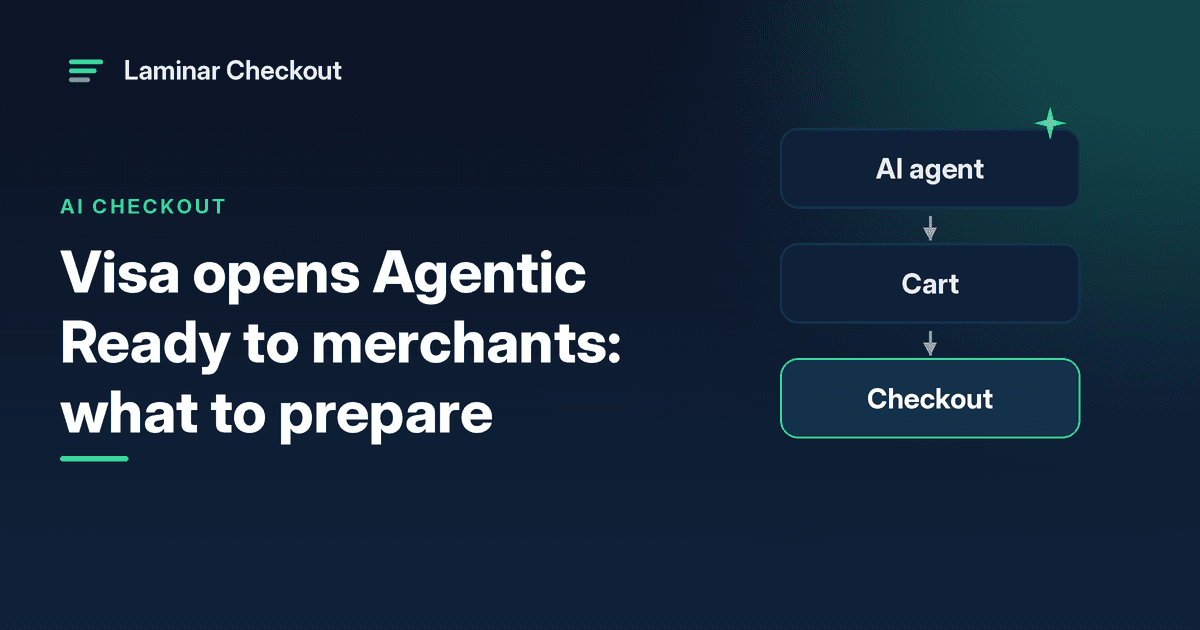
On November 17, 2026, Visa announced that it is expanding its Agentic Ready program to the "acceptance ecosystem": merchants, payment providers, acquirers and commerce platforms. The goal is to test how purchases started by AI agents can move through the payment systems stores already use.
This post separates two things. First, what Visa's announcement says, using the Visa press release. Second, our own view of what store owners can do now. We label our view clearly, because it is not Visa's.
This is general information, not legal advice. Laminar Checkout is independent and not affiliated with Shopify or Visa.
What Visa announced
Per the release, Visa expanded the Visa Agentic Ready program, part of Visa Intelligent Commerce, to the acceptance ecosystem. Here are the main points:
- Merchants, B2B suppliers, payment providers, acquirers and commerce platforms can now join the 175+ issuers already participating across 45 markets.
- The program launches with more than 140 participants. Visa says additional financial institutions, merchants and enablers are expected to join throughout 2027.
- Visa names Adyen, Antom, Billtrust, Checkout.com, Fiserv, Global Payments, PayPal and Stripe among the participants. The release lists other participants too.
- Visa describes the expanded program as a collaborative framework for merchants, payment service providers, acquirers and commerce platforms "to assess how trusted agent-initiated transactions can be recognized, authenticated, and processed."
- Participants can test real-world agentic experiences, which Visa says helps it validate readiness.
Interested merchants and providers are told to contact their Visa representative. The release is a company announcement, so the quotes from participants reflect their own views.
What the release does not say
It helps to know the limits of this news.
- It does not mention Shopify. We have no information on whether or how Shopify stores are involved, and we won't guess.
- It does not set requirements for merchants. The release describes a program to join and test. It doesn't say merchants must take any action or by when.
- It does not discuss store policies, pricing pages or disputes. The focus is payment infrastructure: recognizing, authenticating and processing agent-initiated transactions.
In the release, participants describe work such as recognizing agent-initiated transactions, accepting network tokens and adding agentic signals to risk and fraud tools. Those are payment-layer tasks that mostly sit with your payment provider, not with your store pages.
Our view: agents will still reach your public pages
The rest of this section is Laminar's view. It is not Visa's.
Visa's announcement is about how the payment side recognizes and processes agent-initiated purchases. A shopper or an agent working for them still has to decide where to buy. That decision may rest on what your store says: price, shipping times, return terms and how to contact you.
We can't tell you how any specific AI agent reads a page. But the logic is simple. If software is helping people compare stores and complete purchases, unclear or conflicting pages are a larger risk. A human may skim past a contradiction. A summary, or a dispute later, may not.
We covered how AI channels use store policies in AI shopping agents read your store policies too. The Visa news adds a payments-side reason to keep those pages in order.
What to check on your store
State prices and fees once, the same way everywhere
Show the full price, shipping cost and any fees before the final step of checkout. Keep product pages, cart and checkout consistent. Our post on FTC billing cases shows why mismatched or late fees draw attention.
Publish shipping times as clear ranges
Give processing and transit times separately, in plain text. Update them when they change, and remove old numbers from FAQs and product pages.
Write one refund and return policy
State the window, the conditions, who pays return shipping and when refunds are issued. Don't contradict it elsewhere. How clear checkout policies reduce chargebacks explains why.
Keep contact details visible and current
Show a business name, a monitored support email and a phone number or address. Make them reachable from every page.
Make the pages easy for software to read
This part is our suggestion, not a rule from Visa or any provider:
- Put key terms in normal page text, not only in images, PDFs or pop-ups.
- Use clear headings such as "Returns," "Shipping" and "Contact."
- Avoid terms that change depending on which page the reader sees.
Ask your payment provider
Your provider is the one that works with Visa on this. Reasonable questions include:
- Is it taking part in Agentic Ready or planning to?
- Will it support agent-initiated transactions on your account, and when?
- How would those transactions be identified, and how would disputes on them be handled?
The release does not answer the dispute question, so ask.
A brief note on Klarna
Separately, eMarketer reported on November 17 that Klarna's new AI assistant lets users chat through iMessage, WhatsApp or the Klarna app. Per that article, citing a Klarna press release, it can book reservations, monitor prices, suggest gifts and handle returns. This is a single secondary source, and we have not reviewed Klarna's own announcement.
It is one more sign that shopping help is moving into assistants. Our view: an assistant that helps with returns depends on merchants' return rules being clear. We cover the Klarna and Adyen agentic checkout announcement in Klarna in Adyen Agentic checkout: what your policies should say.
FAQ
Do I need to join Agentic Ready?
The release says merchants and providers can join and should contact their Visa representative. It doesn't say participation is required. Most small stores would work through their payment provider.
Does this mean AI agents are about to buy from my store?
The release says the program is launching and that more participants are expected through 2027. It doesn't give a timeline for your store. Treat it as a reason to tidy your pages, not as a deadline.
Is Shopify part of this?
The Visa release doesn't mention Shopify. Check with Shopify and your payment provider for anything specific to your store.
Will clear policies protect me from disputes?
No. They remove some causes of confusion. Product quality, delivery and service still matter.
Check what an agent or a shopper would see
Run a free scan of your public pages. Laminar checks contact, refund and return, shipping timelines, pricing and fees, privacy and consent, and legitimacy. You get a 0–100 compliance score with pass, warning and fail counts in under a minute, with no app, login or admin access. Results are informational. A scan can't tell you how an AI agent reads your pages or whether your provider supports agent-initiated payments. For a closer look, see our compliance review.